SUP training - how many calories you burn and which muscles actually work
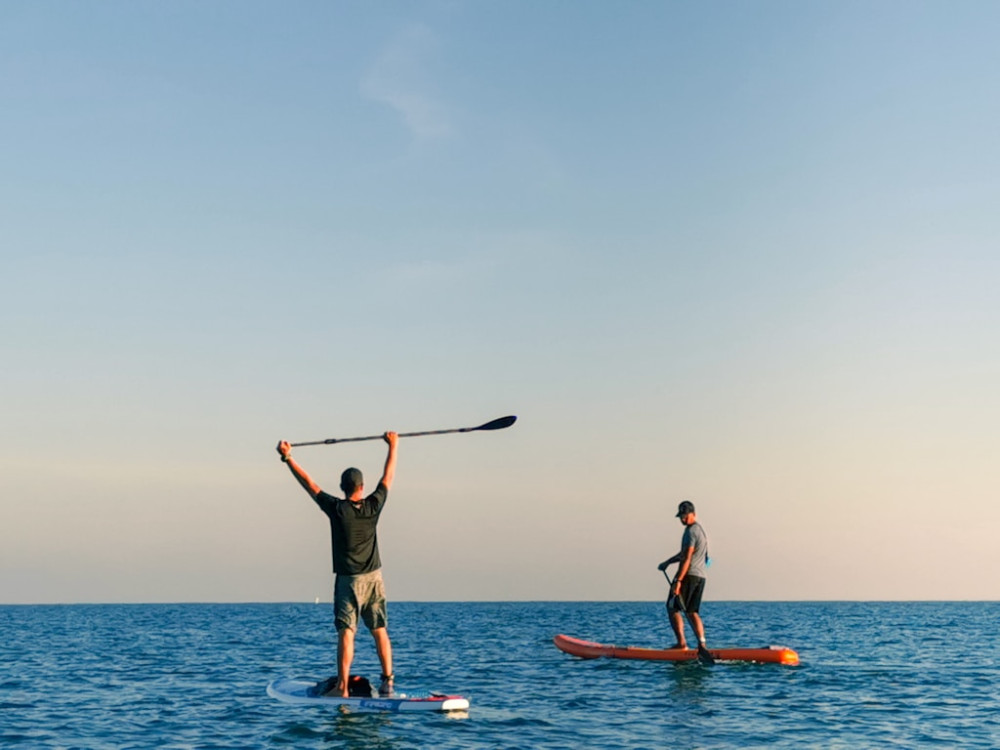
From the shore, stand up paddling looks almost lazy. Someone glides across a flat lake at walking pace, paddle dipping in and out, no splashing, no visible effort. Then you try it yourself, and the next morning your obliques, lats and calves file a formal complaint.
That gap between how SUP looks and how it feels is the whole point. It is one of the very few sports where a beginner can have fun on day one and still get a serious full-body workout without ever feeling like they are training. Below is what actually happens in your body on the water - and how your gear changes the numbers.
Why paddling is harder work than it looks
The paddle stroke is only half of the story. The other half is standing on a surface that will not hold still.
Every ripple, every gust, every boat wake forces dozens of tiny corrections through your ankles, knees, hips and trunk. These micro-adjustments never stop, they never reach failure, and you are barely aware of them - which is exactly why they burn energy for an hour straight. Sports scientists call this postural or stabilising work, and it is the reason a relaxed cruise on a paddleboard costs far more than a relaxed walk.
Add the propulsive work of the stroke on top of that, and you have a rare combination: continuous low-impact cardio plus constant isometric stabilisation, with zero pounding on your joints.
How many calories does SUP burn?
Honest answer first: it depends on your body weight, your pace, the wind, and the board under your feet. A 60 kg paddler on a sheltered bay and a 95 kg paddler pushing into a headwind are doing completely different workouts.
That said, here are realistic working ranges per hour for an adult of average build:
Type of session
Approximate burn per hour
What it feels like
Relaxed cruising, flat water
250–400 kcal
Easy conversation pace
Steady touring pace
400–600 kcal
You can talk, but in short sentences
Interval or race pace
700–1000+ kcal
Talking is not happening
SUP yoga / SUP fitness
350–500 kcal
Low heart rate, very high stabiliser load
Paddling in chop or wind
500–800 kcal
Harder than the same pace on flat water
For comparison, an hour of relaxed cruising sits roughly in the same territory as a brisk hike, while touring pace lands close to a steady jog - except your knees, hips and spine are not absorbing thousands of impacts along the way.
Two practical notes. First, wind is the single biggest variable nobody accounts for; a 12–15 knot headwind can double the effort of an otherwise gentle session. Second, most people underestimate their own session length. Paddling is absorbing, and "quick hour" sessions routinely turn into two.
Which muscles does stand up paddling work?
Almost all of them, but not in equal measure. Here is the honest breakdown, roughly in order of how hard each group works.
Core - the real engine. Your transverse abdominis, obliques and deep spinal stabilisers work in two ways at once: rotating your trunk to drive the stroke, and holding you upright against a moving board. This is why SUP has a reputation as a core sport. It is not marketing. It is the group that will tell you about it the next day.
Back - lats, rhomboids, erector spinae. The pull phase of the stroke is fundamentally a lat exercise. Done correctly, your back does far more work than your arms, and your posture improves over a season because the mid-back muscles that desk work switches off are suddenly doing something for an hour at a time.
Shoulders and rotator cuff. Deltoids stabilise the paddle overhead and control the recovery phase. This is also the most common site of overuse trouble, which is almost always a technique problem rather than a load problem - more on that below.
Arms - supporting cast. Triceps on the top hand, biceps and forearms on the bottom. They should be the least fatigued group at the end of a good session. If your forearms are cooked and your core feels fresh, you paddled with your arms.
Legs and glutes. Quads, hamstrings, glutes and calves work isometrically the entire time you are standing, plus constant ankle stabilisation. On a touring board or in chop, the leg load goes up sharply. Many first-time paddlers are genuinely surprised that their calves are the sorest part of them the next day.
Feet and ankles. Small, unglamorous, and doing thousands of reps. Proprioception improves noticeably over a few weeks, which carries over to running, skiing and pretty much anything else on unstable ground.
The technique that turns a paddle into a workout
The single most common mistake is treating the paddle like an oar and pulling with the arms. It burns your shoulders, produces very little glide, and wastes most of the training benefit.
A better stroke, in four beats:
1. Reach. Hinge forward from the hips, not the lower back, and plant the blade well ahead of your feet. Arms stay relatively straight.
2. Plant. Bury the whole blade before you apply power. A half-submerged blade is a half-effective stroke.
3. Pull yourself past the paddle. This is the mental shift that changes everything. You are not pulling the paddle through the water - you are pulling the board towards a fixed blade, using your core rotation and body weight.
4. Exit at your feet. Anything past your ankles lifts water and pushes the nose down. Take the blade out and reset.
Also, bend your knees. Locked legs turn every ripple into a balance emergency; soft knees act as suspension and quietly recruit your quads and glutes for the whole session.
How your gear changes the training effect
This is where an hour on the water becomes either a great workout or an exercise in frustration.
Board shape decides your workout type. Wide allround boards around 10'–11' are stable, forgiving and ideal for building technique, SUP fitness and yoga. Longer, narrower touring shapes - 12'6" and up — track straighter and glide further per stroke, which is what you want for distance sessions, higher average heart rates and genuine cardio training. Beginners chasing fitness usually do best starting allround and moving to touring once balance is automatic. You can compare both shapes across the full range of SUP boards before deciding.
Paddle weight matters more than people expect. At a typical 50–60 strokes per minute, a one-hour session is around 3000–3600 lifts. Shaving a few hundred grams off the shaft compounds into a meaningfully different level of shoulder fatigue by the end of it. Aluminium paddles are perfectly fine for occasional use; glass and carbon SUP paddles are what regular paddlers gravitate to, and the difference over a long session is not subtle. Length rule of thumb for fitness paddling: your height plus roughly 20–25 cm.
Inflation pressure is free performance. An underinflated inflatable flexes in the middle, sits lower in the water and eats your effort with every stroke. Most modern boards want 15–18 PSI, and hitting that number honestly requires a decent pump - a double-chamber or electric unit is the difference between a workout that starts on the water and one that starts on the beach.
Safety kit is not optional on a training session. A leash keeps your board - your primary flotation device - attached to you when you fall, and you will fall more often when you are training hard than when you are cruising. On open water, cold water or anything with current, add a buoyancy vest. Both are cheap relative to the board and non-negotiable when you are pushing your pace.
A simple three-session week
If you want to treat paddling as actual training rather than a nice day out, this structure works well and needs no coach:
· Session 1 - steady state, 45–60 min. Continuous, comfortable pace. Focus entirely on stroke quality and switching sides every 8–10 strokes to balance out.
· Session 2 - intervals, 30–40 min. After a 10-minute warm-up, do 6–8 rounds of 1 minute hard / 2 minutes easy. This is where the heart rate work happens.
· Session 3 - long and easy, 90+ min. Distance at conversational pace. Builds endurance, and this is the session that makes you fall in love with the sport.
Two of these a week is already meaningful training. Three is a genuine fitness programme.
The quiet advantages
Beyond calories and muscles, SUP does a few things most gym routines do not. It is almost entirely non-impact, which makes it viable for people managing knee or back issues that rule out running. It trains balance and proprioception, which decline with age faster than strength does. And it happens outdoors, on water, usually in the sun - which does more for stress and sleep than any single exercise variable in a gym.
The barrier to entry is also genuinely low. A modern inflatable packs into a backpack, inflates in ten minutes, and fits in a car boot alongside the shopping. Everything you need to start - boards, paddles, pumps, leashes and safety gear - sits in one place in the SUP category, and a complete beginner set costs less than a year of most gym memberships.
The first session will humble your core. The tenth will feel like flying. Somewhere in between, you stop counting calories and just go paddling - which, as workouts go, is about the best outcome there is.
New glastonbury Jobs Section Launched!!
Vacancies updated hourly!!
Click here: glastonbury jobs
Share: